



Bradykinin B1 Receptor (B1R)
Bradykinin B1 receptor (B1R) is rapidly induced after tissue trauma and helps maintain inflammatory responses[1]. Mechanistically, B1R up-regulation in human lung fibroblasts responds to desArg10-kallidin and interleukin-1β through distinct but synergistic tyrosine kinase, p38 MAPK, and NF-κB-sensitive pathways[1]. In inflammatory pain models, kinins activate both B1 and B2 receptors, while des-Arg-BK and des-Arg-KD activate B1R[2]. Compared with B2R, B1R preferentially supports chronic inflammatory pain responses, whereas B2R supports acute-phase responses[2]. Ligand studies further distinguish B1R because high-affinity human B1R binding requires an N-terminal L-lysine interaction with the fourth extracellular domain[3]. For experimental applications, potent B1R antagonists inhibit des-Arg-kallidin binding, phosphatidylinositol turnover, and calcium mobilization, while showing inactivity at B2R[4].
References:
- [1]. Alić I, et al. Patient-specific Alzheimer-like pathology in trisomy 21 cerebral organoids reveals BACE2 as a gene dose-sensitive AD suppressor in human brain. Mol Psychiatry. 2021 Oct;26(10):5766-5788.
- [2]. Wong CT, et al. Orally active peptidic bradykinin B1 receptor antagonists engineered from a cyclotide scaffold for inflammatory pain treatment. Angew Chem Int Ed Engl. 2012 Jun 4;51(23):5620-4. [Content Brief]
- [3]. Fathy DB, et al. High-affinity binding of peptide agonists to the human B1 bradykinin receptor depends on interaction between the peptide N-terminal L-lysine and the fourth extracellular domain of the receptor. Mol Pharmacol. 2000 Jan;57(1):171-9.
- [4]. Horlick RA, et al. Small molecule antagonists of the bradykinin B1 receptor. Immunopharmacology. 1999 Sep;43(2-3):169-77. [Content Brief]
-
Bradykinin B1 Receptor (B1R) Related Products (11)
Related Products (11)

- 1
-
[Des-Arg9]-Bradykinin acetate
![[Des-Arg9]-Bradykinin acetate](https://file.medchemexpress.com/product_pic/hy-p0298a.gif "Click to View [Des-Arg9]-Bradykinin acetate Product Detail") 0 Images[Des-Arg9]-Bradykinin acetate is a Bradykinin B1 receptor agonist that displays selectivity for B1 over B2 receptors.
0 Images[Des-Arg9]-Bradykinin acetate is a Bradykinin B1 receptor agonist that displays selectivity for B1 over B2 receptors.
-
SSR240612
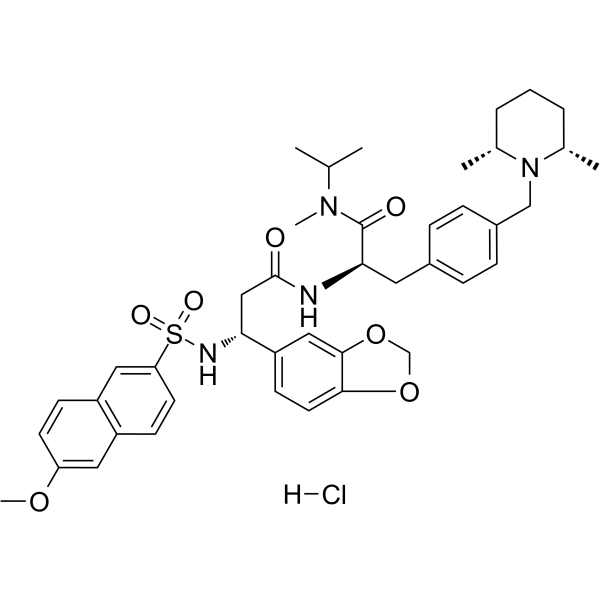 0 ImagesSSR240612 is a potent, and orally active specific non-peptide bradykinin B1 receptor antagonist, with Kis of 0.48 nM and 0.73 nM for B1 kinin receptors of human fibroblast MRC5 and HEK cells expressing human B1 receptors, 481 nM and 358 nM for B2 receptors of guinea pig ileum membranes and CHO cells expressing human B1 receptor, respectively.
-
Mergetpa
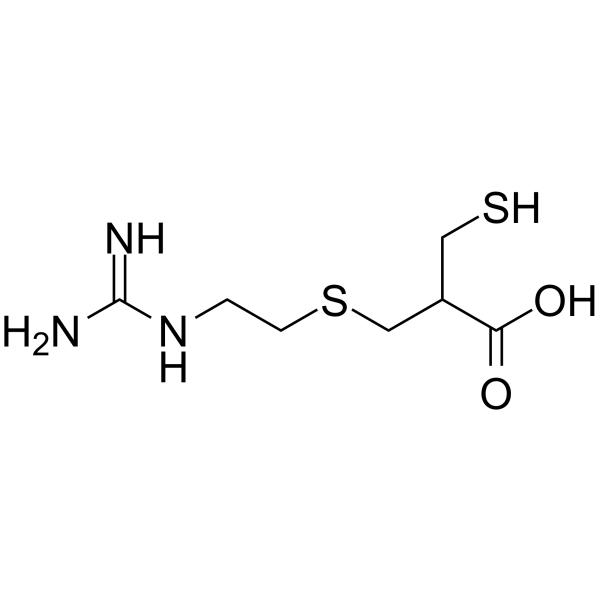 0 ImagesCat. No.: HY-W704574CAS No.: 77102-28-4Mergetpa is a reversible Arg-carboxypeptidase inhibitor with high affinity. Mergetpa reduces B1R. Mergetpa blocks the overexpression of IL-1β protein and mRNA in glucose-fed rats. Mergetpa significantly increases the expression of IL-1β protein in the renal cortex. Mergetpa is used to block the conversion of kinins and B2 receptor antagonists into metabolites lacking the C-terminal arginine. Mergetpa inhibits the time-dependent enhancement of the response of isolated rabbit aorta to bradykinin. Mergetpa preserves the chemotactic activity of full-length SDF-1α on cells. Mergetpa reverses hyperglycemia, excessive weight gain, elevated levels of oxidative stress markers and overexpression of inflammatory markers in glucose-fed rats.
-
Lys-[Des-Arg9]Bradykinin TFA
![Lys-[Des-Arg9]Bradykinin TFA](https://file.medchemexpress.com/product_pic/hy-103295a.gif "Click to View Lys-[Des-Arg9]Bradykinin TFA Product Detail") 0 ImagesLys-[Des-Arg9]Bradykinin TFA, a naturally occurring kinin, is a potent and highly selective bradykinin B1 receptor agonist with a Ki of 0.12 nM, 1.7 nM and 0.23 nM for human, mouse and rabbit B1 receptors, respectively. Lys-[Des-Arg9]Bradykinin TFA has low inhibitory activity on B2 receptors.
0 ImagesLys-[Des-Arg9]Bradykinin TFA, a naturally occurring kinin, is a potent and highly selective bradykinin B1 receptor agonist with a Ki of 0.12 nM, 1.7 nM and 0.23 nM for human, mouse and rabbit B1 receptors, respectively. Lys-[Des-Arg9]Bradykinin TFA has low inhibitory activity on B2 receptors.
-
[Des-Arg9]-Bradykinin
![[Des-Arg9]-Bradykinin](https://file.medchemexpress.com/product_pic/hy-p0298.gif "Click to View [Des-Arg9]-Bradykinin Product Detail") 0 ImagesCat. No.: HY-P0298CAS No.: 15958-92-6[Des-Arg9]-Bradykinin is a Bradykinin (B1) receptor agonist that displays selectivity for B1 over B2 receptors.
0 ImagesCat. No.: HY-P0298CAS No.: 15958-92-6[Des-Arg9]-Bradykinin is a Bradykinin (B1) receptor agonist that displays selectivity for B1 over B2 receptors.
-
Lys-(Des-Arg9,Leu8)-Bradykinin TFA
 0 ImagesCat. No.: HY-P4676ALys-(Des-Arg9,Leu8)-Bradykinin TFA is a selective bradykinin B1 receptor (BDKRB1) antagonist. Lys-(Des-Arg9,Leu8)-Bradykinin TFA inhibits local inflammatory edema. Lys-(Des-Arg9,Leu8)-Bradykinin TFA induces the production of systemic acute-phase proteins. Lys-(Des-Arg9,Leu8)-Bradykinin TFA is applicable to research related to peptidoglycan-polysaccharide-induced acute arthritis.
-
[Des-Arg10]-HOE I40 TFA
![[Des-Arg10]-HOE I40 TFA](https://file.medchemexpress.com/product_pic/hy-p5518a.gif "Click to View [Des-Arg10]-HOE I40 TFA Product Detail") 0 ImagesCat. No.: HY-P5518APurity: 99.84%[Des-Arg10]-HOE I40 TFA is a potent bradykinin B1 receptor antagonist.
0 ImagesCat. No.: HY-P5518APurity: 99.84%[Des-Arg10]-HOE I40 TFA is a potent bradykinin B1 receptor antagonist.
-
B 9430
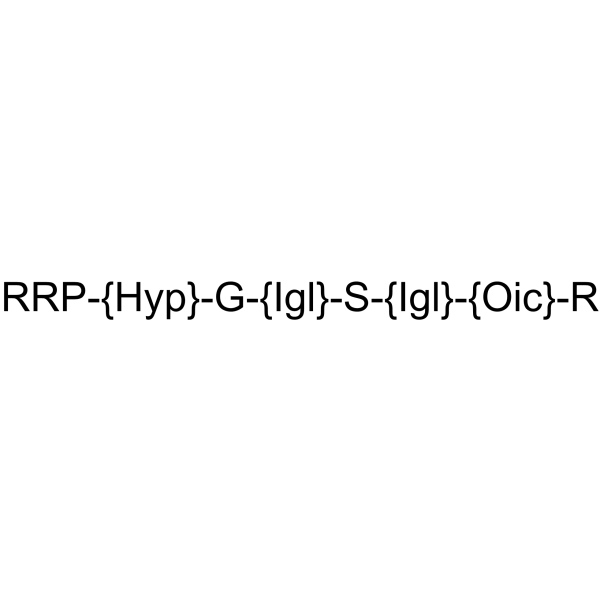 0 ImagesCat. No.: HY-P3232CAS No.: 180981-09-3B 9430 is a potent bradykinin B1/B2 receptor antagonist.
-
JMV-1645
 0 ImagesCat. No.: HY-P2109CAS No.: 284037-77-0JMV-1645 is a potent and selective B1 bradykinin receptor antagonist with a Ki value of 0.023 nM on the human cloned B1 receptor. JMV-1645 can be utilized in trauma and infection research.
-
(Rac)-MK 0686
 0 ImagesCat. No.: HY-15042ACAS No.: 1159193-97-1(Rac)-MK 0686 is the racemate of MK 0686. MK 0686 is a bradykinin B1 receptor antagonist.
-
Breceptin
 0 ImagesCat. No.: HY-P1650CAS No.: 215713-39-6Synonyms: B 9870Breceptin (B 9870) is an antagonist of the bradykinin B1/B2 receptor (B1/B2R). Breceptin exhibits an irreversible antagonist effect on B2R, inhibiting the vasodilation induced by Bradykinin (HY-P0206) in the rabbit carotid vein contraction experiment. B-9870 shows partial agonist properties in HEK 293 cells with high expression of B2R, and can activate ERK1/2 phosphorylation, calcium ion mobilization, arachidonic acid release, and receptor internalization. Breceptin can be used in research to inhibit breast cancer and non-small cell lung cancer.
- 1



